
Cat Math: The Terrifying Physics of Why Your Feline Thinks Your Face Is a Landing Pad at 3 AM
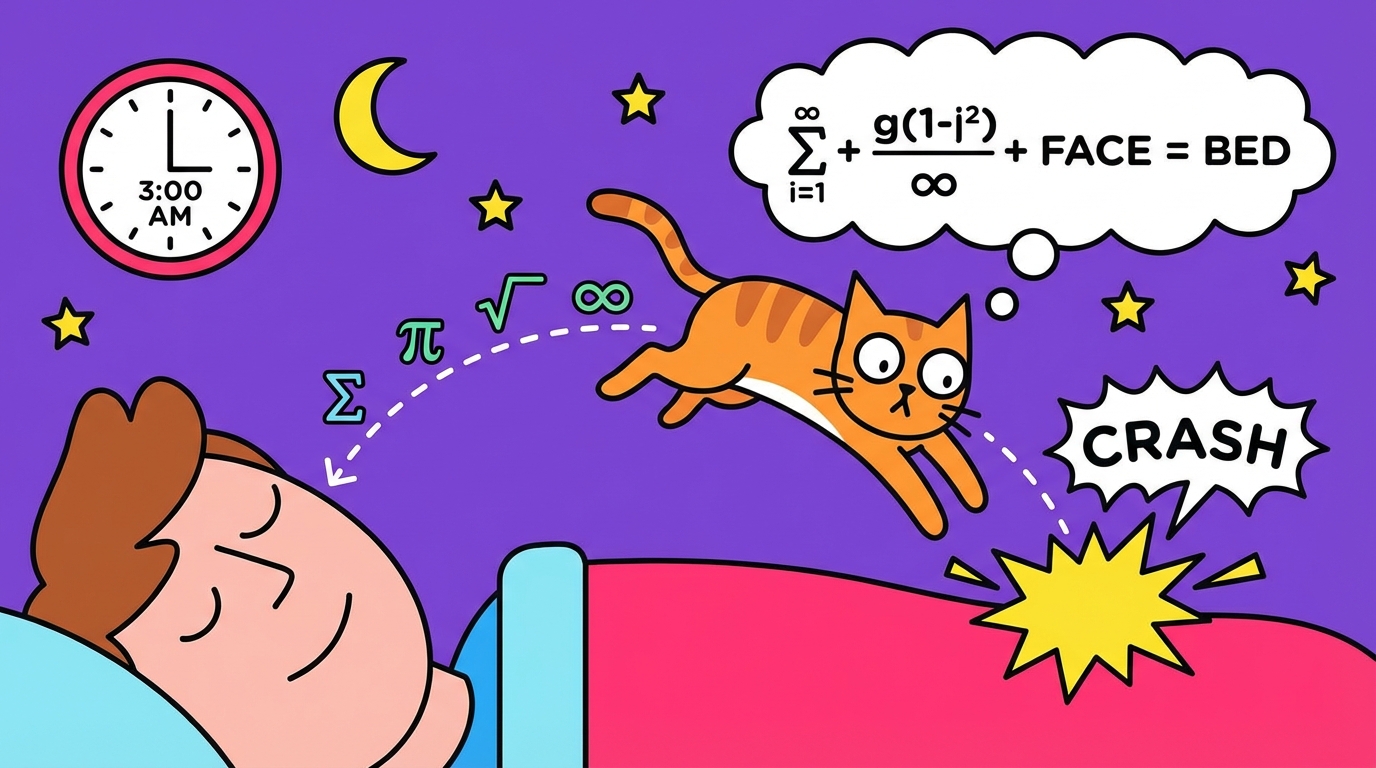
If you have ever shared a living space with a feline, you know that they do not obey the laws of physics, the mandates of the local government, or the basic rules of common sense. But nowhere is the breakdown of reality more apparent than in the realm of "Cat Math." To a human, one plus one equals two. To a cat, one plus one equals a frantic 3:00 AM sprint across your windpipe and a shattered heirloom vase.
Cat math is a specialized branch of non-Euclidean geometry where the shortest distance between two points is always through a closed door that the cat didn’t even want to go through until you shut it. It is a logic system where a five-pound tabby can somehow exert four hundred pounds of downward force on your bladder the moment you drift off to sleep, yet become light as a feather when it’s time to leap onto the top of the refrigerator to judge your choice of snacks.
Consider the "Bowl Volume Theorem." According to feline calculations, a bowl that is 92% full of premium salmon kibble is mathematically equivalent to zero. If the cat can see even a single millimeter of the ceramic bottom, they are officially starving to death. They will look at the bowl, look at you, and let out a mournful wail that suggests they haven't eaten since the mid-Victorian era. In cat math, the perimeter is the only part that exists; the center is a void, a dark hole of nutritional despair.
Then we have the "Space-Time Paradox of Boxes." A cat can be twenty inches long and twelve inches wide, yet they will attempt to occupy a box designed for a single deck of playing cards. Through the magic of cat math, they will successfully liquefy their skeletal structure until they fit. Conversely, if you buy them a $200 deluxe memory foam cat bed with a built-in heater, that bed occupies "Negative Space." It does not exist. The cat will instead choose to sleep on a discarded receipt for a pack of gum that fell behind the radiator.
Finally, there is the "Nap-to-Chaos Ratio." For every eighteen hours a cat spends in a state of motionless slumber, they must generate exactly forty-five minutes of pure, unadulterated poltergeist energy. This energy cannot be destroyed; it can only be converted into the sound of "skittering" on hardwood floors or the rhythmic scratching of a sofa arm that you specifically bought a protective cover for. When the math finally adds up to "Nope," you just have to accept it. You aren't the tax-payer in this house; you're just the person who hasn't realized that in the world of cats, the house always wins.






Comments (0)
Log in or sign up to leave a comment.
No comments yet. Be the first to comment!